THE ART
OF ESCAPE
For more than a century, escape artists have turned the straitjacket into a theatrical challenge: simple enough for an audience to understand at a glance, difficult enough to build an entire performance around. Is it your turn next?


WHY THE STRAITJACKET?
Houdini did not invent escape artistry—and he was not the only performer using straitjackets—but he understood how to turn an escape into an event.
A handcuff can hide its mechanism in a few inches of steel. A straitjacket turns the performer's entire body into the puzzle. The audience can see the sleeves, the straps, the buckles and the struggle. They do not need to know anything about magic to understand the question: how is anyone getting out of that?
Houdini learned that the audience did not only care about the moment he got free. They cared about seeing the problem, watching the struggle develop, and wondering whether this attempt might be the one that defeated him. That lesson is still relevant to escape performers today: the method matters, but the presentation is what turns an escape into a show.
That is one reason the straitjacket became one of the lasting symbols of escape magic.
TRICKED VS TRADITIONAL STRAIGHTJACKETS?
A secret does not make a performance fake. Magic has always mixed apparatus, technique, showmanship and skill. The interesting question is what kind of illusion the performer wants to create.
Tricked / gaffed
The features included in a magician's straitjacket can matter just as much as the features left out. The audience may see a convincing straitjacket while the performer understands details that make the apparatus more predictable on stage.
- Fewer back straps can make the jacket faster to put on and easier to manage during a show.
- A larger, boxier fit can give the performer more room to move.
- Some performance jackets may hide adjustability, extra slack, or other performer-friendly construction.
- A wider or less restrictive collar can change how the jacket feels without looking dramatically different from the audience.
That does not make the act fake. A stage prop is allowed to be designed for the stage. The skill is in how the performer uses the equipment, controls what the audience notices, and builds suspense around the escape.
Traditional-style
A traditional canvas jacket is not trying to quietly help the performer. Its construction is intended to limit movement, resist shifting, and keep the wearer securely contained when it is properly fitted and applied.
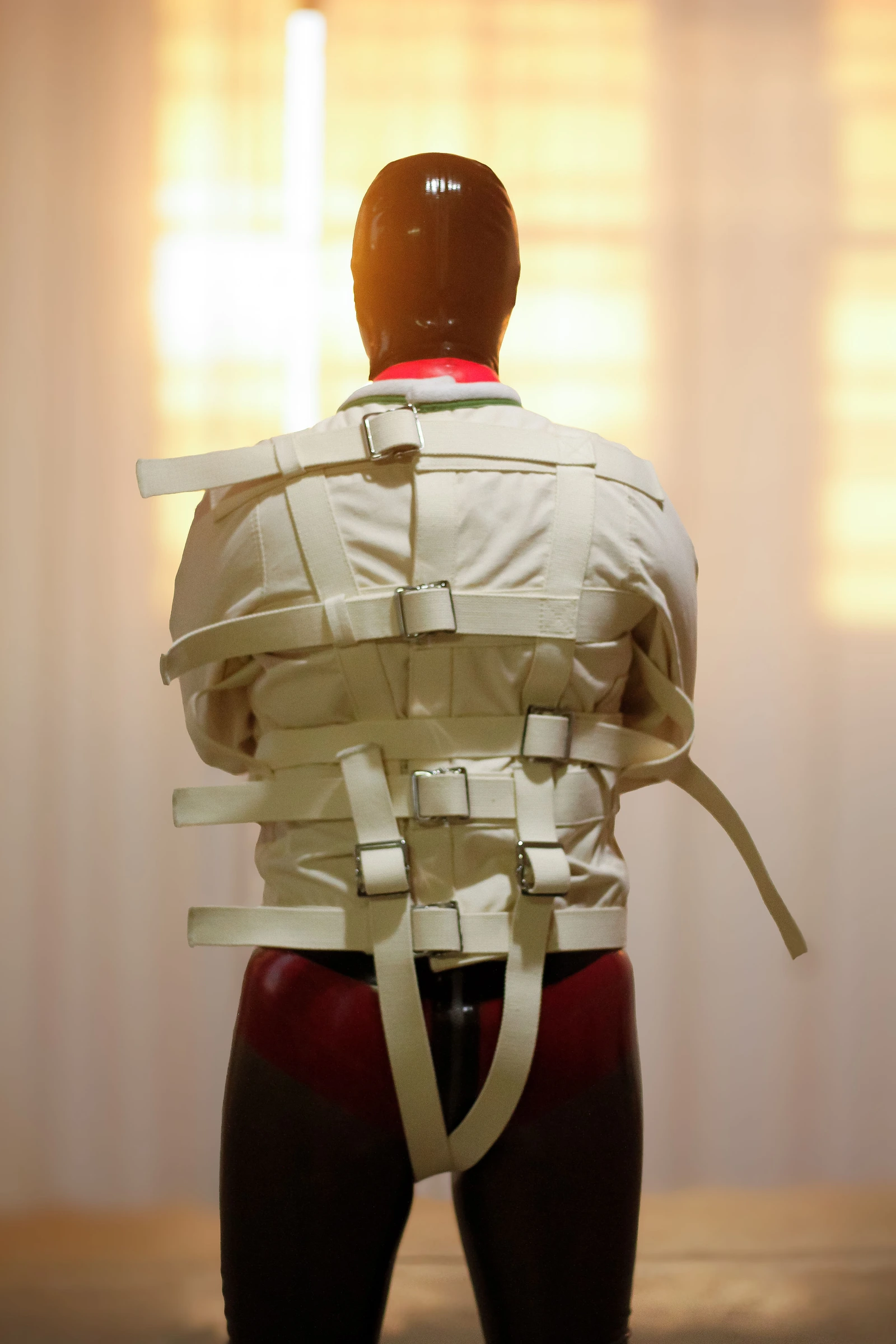
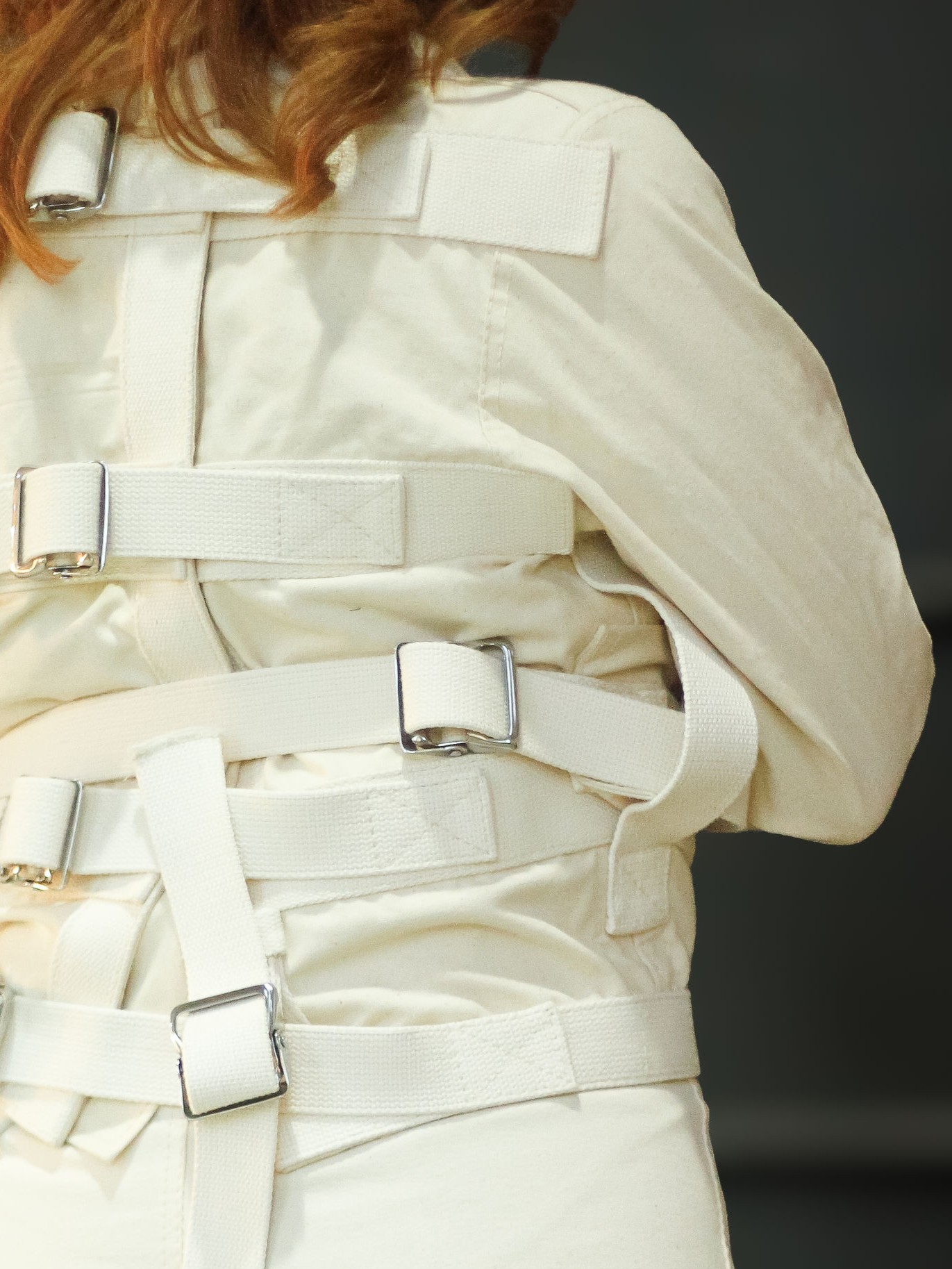
- Several secure back straps, plus a crotch strap, help hold the body of the jacket in place.
- Front and side control loops can keep the sleeves close to the torso and reduce how far the arms can be lifted.
- A closer, more fitted body leaves less unused space to work with.
- An adjustable collar allows the jacket to be fitted more closely around different wearers.
- Heavy, stiff canvas makes bending, bunching and repositioning the garment more demanding.
For an escape artist, this kind of jacket changes the question from “Where is the secret?” to “How well do I understand the apparatus, my own movement, and the performance I am building around it?”
One strap can change the whole challenge.
The most common trick or gaff hidden in a performance straitjacket is an arm strap that can be gripped by the wearer on the inside and released to give extra slack.
This animation is of a tricked straitjacket in my personal collection.
WHAT MAKES A POSEY-STYLE
JACKET CHALLENGING?
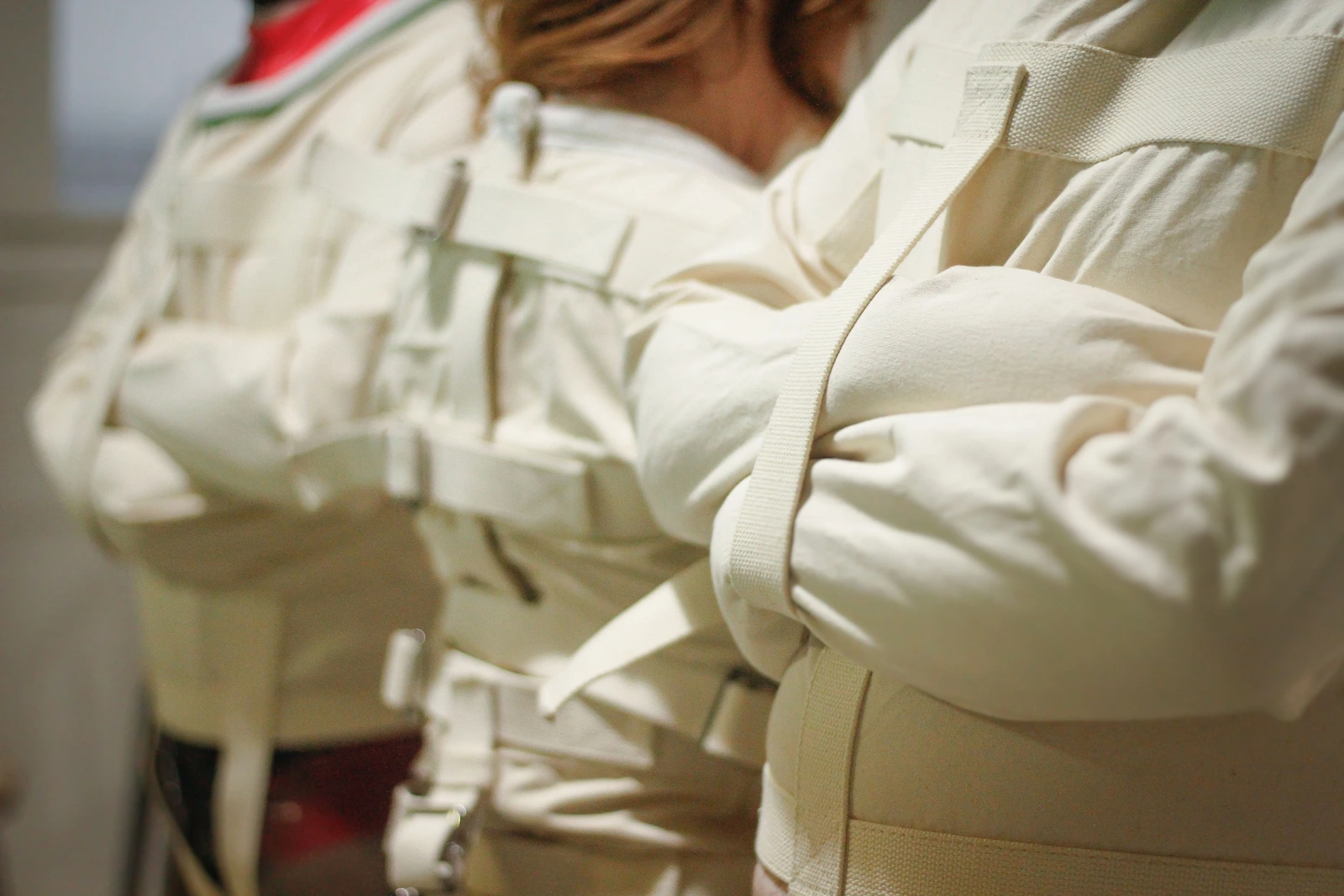
The classic canvas design is challenging to an escape artist because so many separate parts work together. None of them needs to be mysterious. The challenge comes from how the whole jacket controls movement—and from understanding which details matter most once the jacket is actually fitted to a person.
Closed, extended sleeves
The hands stay inside the sleeves, taking ordinary hand use out of the equation and turning the arms themselves into part of the puzzle. The length of the sleeve relative to the arm inside can make a big difference.
Vertical control loops
In a properly applied straitjacket, the arms are not simply crossed in a loose self-hug. The sleeves pass through a vertical control strap on the front of the torso, and some designs add side loops as well. These features help keep the arms close to the body and reduce how much the sleeves can wander.
Closures are behind you
Multiple back straps put the ordinary fastening points where the wearer cannot simply look at or reach them normally. The Posey straitjacket uses a strap with infinite adjustability while many performance jackets use a belt with only a few adjustment options.
The crotch strap
This strap anchors the lower part of the jacket and helps prevent the body of the jacket from simply riding upward. On a traditional design, that makes it an important part of both fit and restraint.
Stiff canvas
Traditional heavy canvas does not move like a sweatshirt. The material itself resists folding, twisting and bunching.
No secret quick release
Our reproduction is built as a traditional-style jacket, not around an invisible magician's release. For an escape artist, that puts the focus back on understanding the apparatus, preparing carefully, and building a performance around a genuine physical challenge.
WHAT SHOULD AN ESCAPE ARTIST NOTICE?
Before thinking about getting out, an escape artist should learn to look at a straitjacket as a piece of equipment. The most useful questions are about construction, fit and control—not about hunting for a single magic trick.
What is actually controlling movement?
Look at where the straps anchor, which parts of the jacket keep the sleeves close to the body, how the lower edge is held in place, and whether the material itself is flexible or stubborn. A jacket is a system, but some buckles may be more important than others.
How closely does it fit the wearer?
A loose costume and a fitted restraint can look similar in a photograph but behave very differently. Sleeve length, torso room, collar adjustment and strap placement all change how much unused space remains inside the garment.
Was the jacket applied the way it was designed?
A traditional jacket only demonstrates its intended design when its control loops, straps and adjustments are actually used. For a performer, understanding the difference between the jacket itself and the way it has been applied is part of understanding the apparatus.
OUR CANVAS POSEY REPLICA
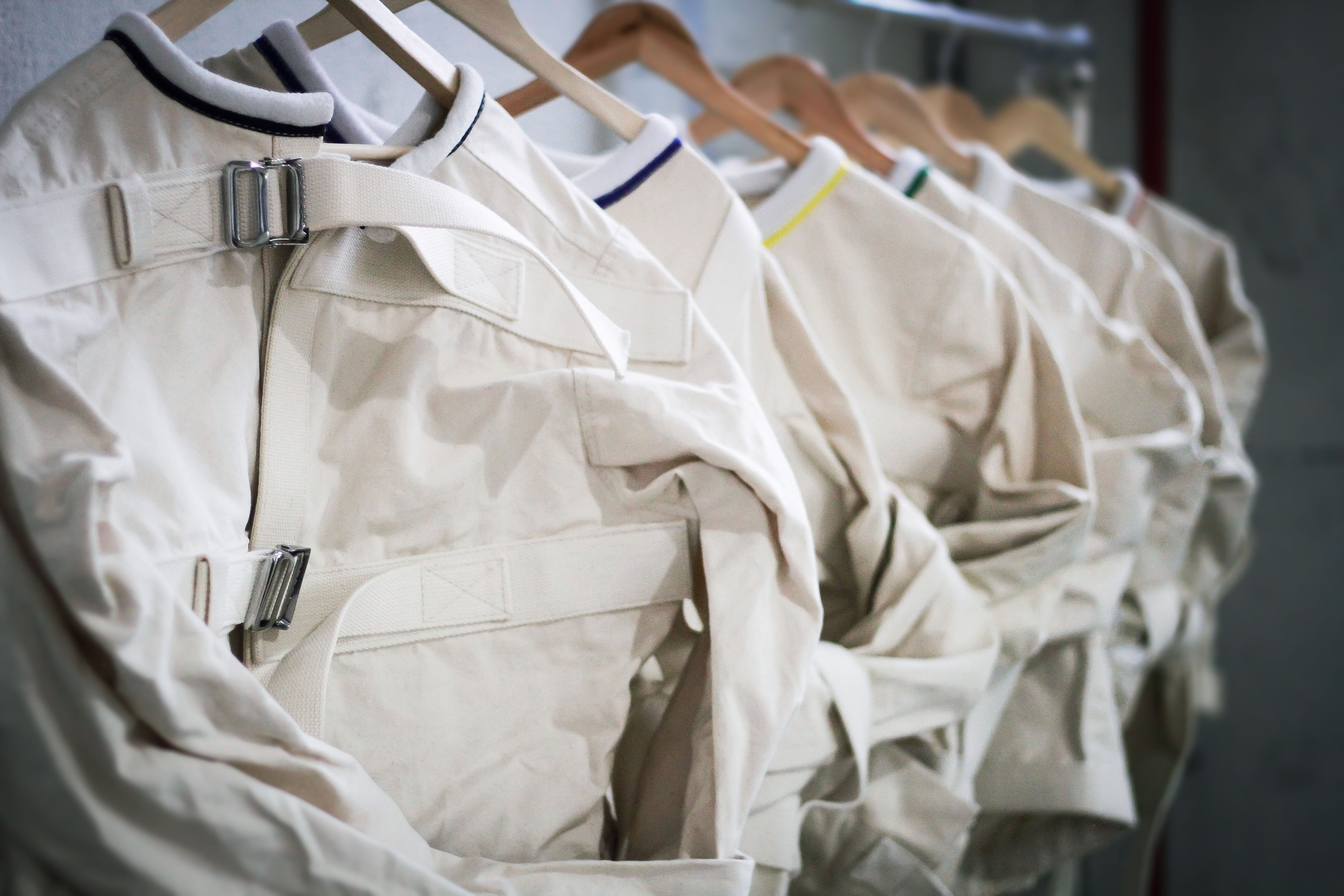
Straitjacket Struggles is a small business created out of a personal love for straitjackets. My own introduction started with researching escape artists, and that curiosity eventually grew into making sure other people could get their hands on good-quality straitjackets without having to settle for a costume or a mystery listing.
Our Posey replica is a reproduction of one of the most quintessential straitjacket designs from institutional use. It was not designed as a stage magician's trick jacket. The goal is to preserve the recognizable canvas construction—enclosed sleeves, substantial rear straps, control loops, a crotch strap, and a close-fitting body—and to make a jacket that is genuinely difficult to escape when properly fitted and applied.
With the right allowances escape is still possible and I hope you consider our product for your straitjacket struggle.
See the Canvas Posey Replica Escape & countermeasureESCAPE & COUNTERMEASURE
I believe learning how to keep the escape artist securely inside the straitjacket is as important as the escape artist learning how to escape. This section will discuss common techniques to make escaping easier, and the countermeasures that make them more difficult. An escape artist learns by noticing what creates freedom of movement; a well-designed, properly applied jacket works in the opposite direction by taking that freedom away. Looking at both sides together makes the challenge much easier to control.
Unused room and slack
Extra space inside the body or sleeves gives the performer more freedom to reposition arms, shoulders and fabric.
Preserve working room
A performer may choose a larger size as a first step. They may take a deep breath in and hold their chest as large as possible when those straps are being tightened.
Close, correct fit
A properly sized jacket removes much of that unused space. Torso fit, collar adjustment and strap position all matter. For the assistant, making a second pass at the straps later may reveal hidden slack.
Mobility in the arms
The most common escapes involve getting one's arms up over the head so the strap is no longer wrapped around the body. The alternate is getting the buckle securing the arms together within reach to undo it.
Preserve sleeve travel
A performance jacket may omit some control loops or be gaffed like the above animation. In the absence of these features the performer is advised to hold their elbows out, and provide the illusion of being snugly buckled while keeping the ability to hug themselves tighter.
Front and side control loops
The vertical front loop and side loops on some jackets prevent vertical movement. If a straitjacket does not have these features you can pass the arm strap under one of the back straps for the same effect. Just like the back straps, making a surprise revisit to look for slack given up can help prevent escape.
A jacket that can shift on the body
If the whole garment can ride upward or rotate, the performer may gain movement even though none of the buckles changed.
Preserve garment movement
Beyond the original fit and slack you maintain in the application, shifting can be an incremental process. Feel for bunching material and work on passing the loose material from one side to the other so one arm has all the mobility.
The crotch strap and lower anchoring
Anchoring the bottom of the jacket helps keep the torso in the position the rest of the restraint was designed around. Some designs may allow for the arm strap to be attached to or with one of the back straps, anchoring against rotation.
Access to something useful
An escape becomes easier whenever a fastening, strap end or useful piece of slack can be brought into a workable position.
Preserve useful access
Stage conditions can be planned so there are no surprises: the performer knows the jacket, the strap layout, and what parts of the apparatus remain reachable. In off-stage areas, having fixed objects to rub against or hooks to use to pull against can make useful tools.
Rear-facing closures
The stage is a barren place with no tools or fixed objects to help out. With the buckles placed behind the wearer they are out of sight and out of normal reach. You probably don't have a padded cell at home. In an off-stage environment, limiting access to environmental tools can make escape more difficult.
Flexible material
Soft material is easier to fold, bunch and shift, which can change how the garment behaves during an attempt.
Preserve flexibility
Some performance jackets use softer or lighter materials so the garment moves more easily and behaves consistently in rehearsal and onstage.
Heavy canvas and reinforced straps
Stiffer material resists being compressed or repositioned and helps the jacket keep the shape its straps are trying to impose.
A performer-friendly feature
A gaffed sleeve strap, concealed slack or another stage-oriented detail can give a performer an advantage the audience does not immediately see.
Preserve the gaff
A tricked jacket depends on consistent preparation. The performer checks the concealed feature, rehearses the same setup, and makes sure the prop behaves the way the act expects.
Traditional fixed construction
A traditional-style jacket does not provide that hidden advantage. The performer has to work with the fit, construction and mobility the jacket actually gives them.
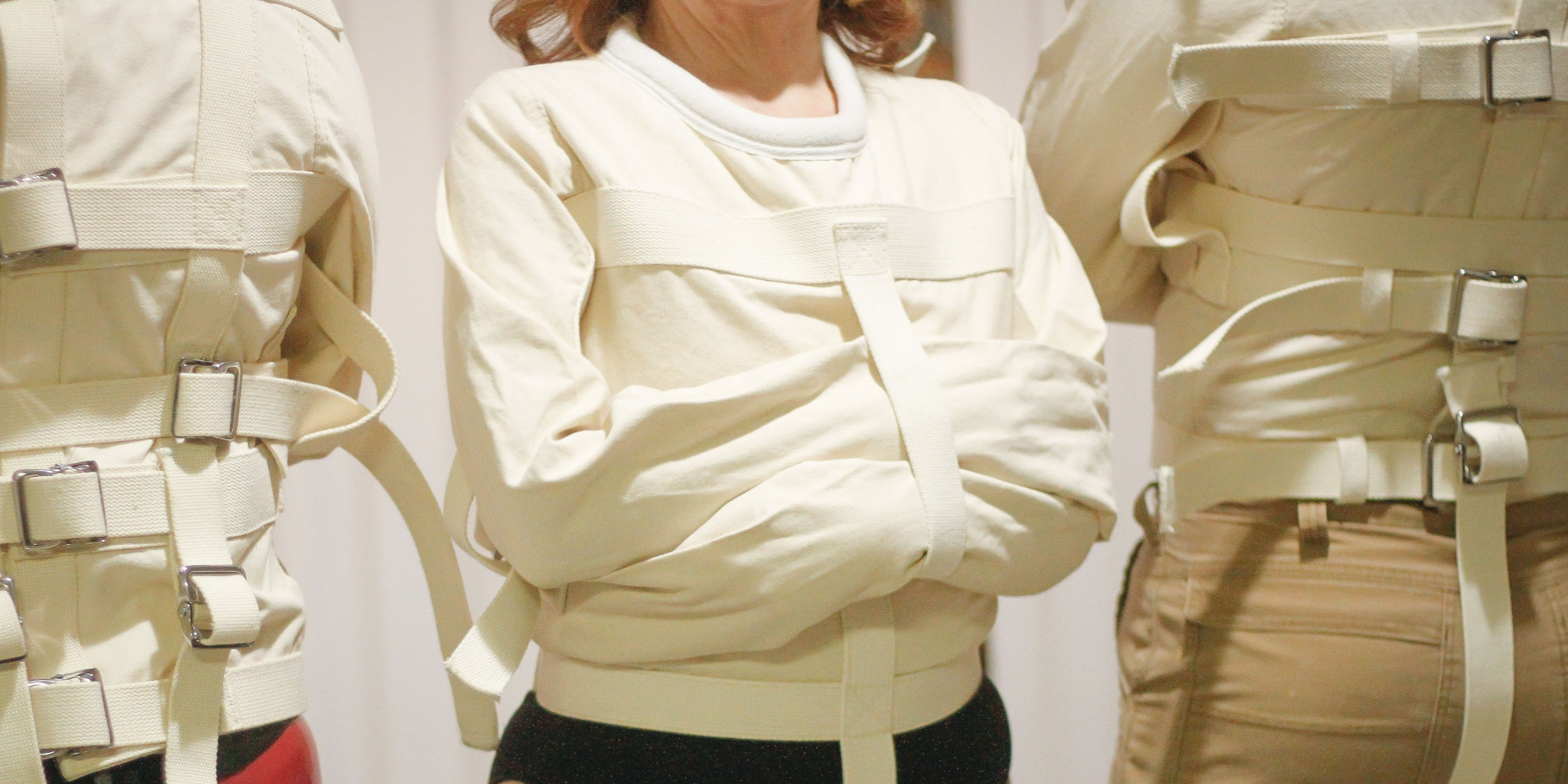
THERE ISN'T JUST ONE THING TO “BEAT.”
A traditional straitjacket is difficult because its features overlap. The rear straps hold the body closed. The sleeve restraint controls the arms. The vertical loop controls where those sleeves can travel. The crotch strap helps keep the whole garment from shifting. Heavy canvas resists being folded out of the way.
That is also why application matters so much. Leaving one part loose can change the whole puzzle. For an escape performer, learning to recognize those relationships is more useful than memorizing a single “secret move.”
ESCAPE ART IS
PERFORMANCE ART.
The audience needs to understand the problem.
A good escape begins before the performer is restrained. The audience has to see enough of the apparatus to believe the challenge matters. Many acts let an audience member inspect the straitjacket, watch the straps being applied, or even help with part of the setup. The point is not only to prove that the jacket exists—it is to make the audience emotionally invest in the problem.
The struggle tells a story.
Houdini discovered that watching the escape could be more exciting than merely waiting for the result. Movement, pacing and personality are part of the act. A performer who could finish instantly might still choose not to make the finish feel instant; a performer whose attempt takes longer than expected needs enough composure and showmanship to keep the audience with them. Practice is partly about the escape and partly about knowing how to perform through uncertainty.
The method is not the whole magic trick.
Whether the apparatus is tricked or traditional, the performer still has to create suspense and make the audience care about the finish. When you watch other straitjacket escapes, pay attention to what the audience is allowed to notice, what the performer emphasizes, and how the timing of each visible breakthrough changes the story of the act.
LEARN THE ART.
RESPECT THE APPARATUS.
Escape equipment deserves the same attitude as gymnastics equipment, climbing gear or a stage illusion: understand it first, involve another responsible person, and do not add danger just because a famous performer once did.
Interest in escape magic can be an interest in theater, history, engineering, puzzles and performance all at once. Providing a safe, controlled environment for that curiosity can be incredibly valuable. I hope this site is a useful first step: learn what a straitjacket is, how the design works, why performers find it interesting, and how professionals think about preparation before anyone tries to turn the idea into a stunt. If a young performer wants to work with real restraint equipment, an attentive adult should stay part of the process. It is also a good opportunity for an age-appropriate conversation about consent, appropriate use, as well as the possibility of abuse, historical or current.